Talk to a robot today, or a human tomorrow. That is the tradeoff a lot of recruiting, TA and HR teams believe they are facing right now. Credit to John Baldino and Jackye Clayton, who dug into this on their October 29 But First Coffee livestream. They talked through the hard choice between AI interview robots and recruiter led phone screens, where teams pick one or the other.
We think there is a better answer. Let candidates choose. And with Honeit, the human option does not have to wait.
Should candidates talk to interview robots or human recruiters?
Let candidates choose. Most candidates and hiring managers still trust a real conversation with a human recruiter more than an AI interviewer, and the speed gap that pushes teams toward robots can be closed with round robin scheduling, one click calling and instant candidate presentations.
Why speed became the excuse for AI interviewers
The first conversation, the one that sets the tone for the whole process, is increasingly being handed to an AI interviewer. The pitch is always the same: speed. No waiting on a recruiter's calendar. No gap between application and first call.
Speed matters. Great candidates are off the market fast, and every day of delay costs you someone. But speed has become the excuse for taking the human out of the moment where a human matters most. And when you look closely at where hiring actually slows down, the conversation was never the problem.
Ask candidates and most will tell you a real conversation is how they learn about the role, the team and whether the company actually wants them. It is how they tell the story behind the resume and ask the questions they care about. Hiring managers feel the same way. They trust a recruiter's read and a real conversation far more than a score from a process they cannot see.
What everyone loses when the robot does the talking
Trust. Candidates know when a machine is screening them, and many disengage. The people with the most options are often the first to drop out.
Nuance. A great recruiter hears the hesitation in an answer, notices the career pivot that actually makes sense, and catches the motivation that does not show up on paper.
Follow up questions. The most valuable moment in any screen is the second question. "Tell me more about that." That is where real skill and real fit show up, and where scripted automation falls short.
Craig Fisher, Head of Talent Acquisition Operations at Rosendin, put it plainly on the Honeit Podcast when describing how his team hires electricians at volume:
"The point though is it's not just technology. We could put an automated robot on to talk to all of them and then just hire them. But you get a couple of bad players in the locker room... it can kind of sour the whole thing. And so you definitely want people who are the right fit still. And so a conversation goes a long way."
The real bottleneck is everything after the conversation
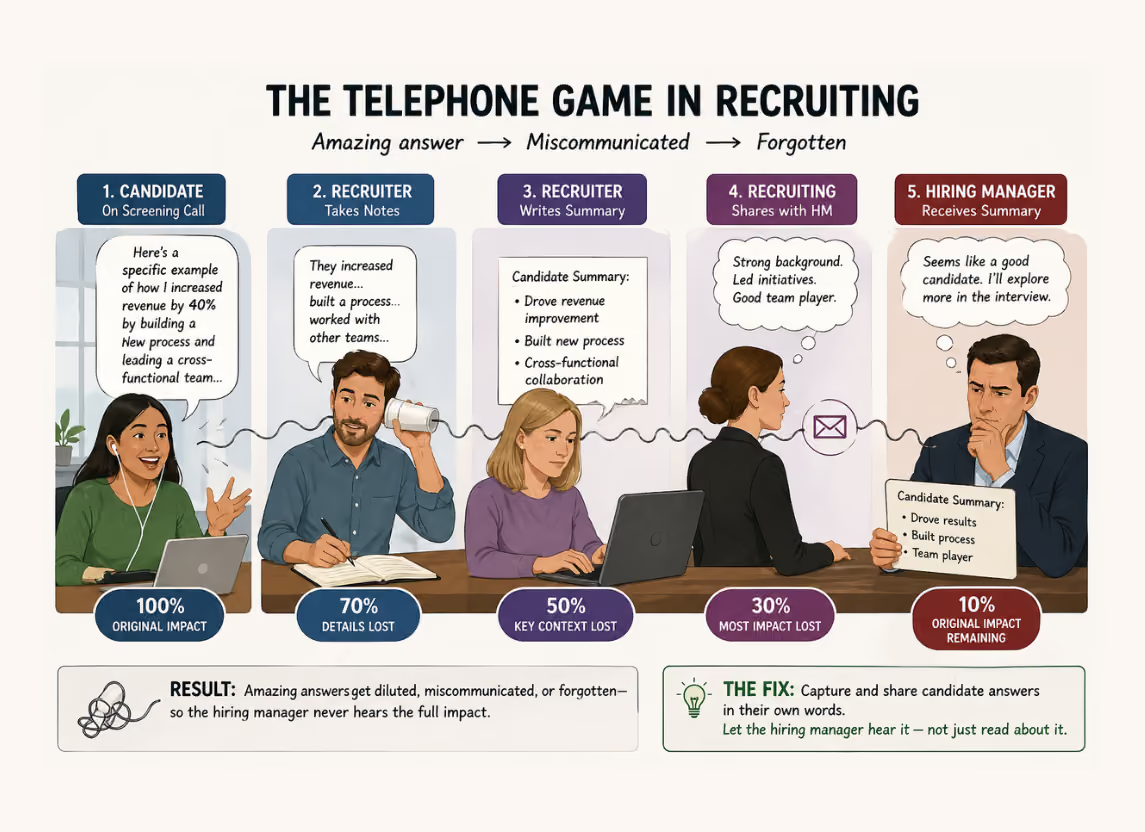
Here is what most teams discover when they map their process honestly. The call takes thirty minutes. Everything after it takes days.
The recruiter writes up notes from memory. Someone formats a submittal. The hiring manager gets a resume and a few lines of summary, then waits for time to review it. Feedback comes back slowly, if at all. Candidates sit in limbo.
Craig described the same realization at Rosendin:
"We can attract the talent. We can get them in here, but we can't push them through the process fast enough to convert them all."
AI interviewers replace the conversation, which was working, and leave the slow handoffs in place. The faster path is to keep the human conversation and make everything around it instant.
But what about...
...the wait to talk to a human?
This is the fair pushback, and it is the whole reason teams reach for a robot. If a candidate has to wait on one recruiter's calendar, automation wins on speed by default. Honeit gives teams two ways to close that gap.
Scheduling automation. Honeit has built in round robin scheduling links for Honeit projects and pipelines. Instead of booking with one person, candidates self book the soonest open slot from availability pooled across recruiters or a whole recruiting team. When your team spans time zones, one link can pool availability around the globe, so candidates can book a live conversation after their own workday, in their own time zone, often the same day.
Outbound calling. Recruiters do not have to wait for candidates to book. With the Honeit Chrome extension, a recruiter who spots the right person on LinkedIn, Indeed or in the ATS can call them with one click and submit them with one click, without changing tabs.
...cost? AI is cheaper at scale.
Most of a recruiter's time does not go into conversations. It goes into the work after the call: summaries, submittals and scorecards. Honeit removes that work, so recruiters spend their time on the conversations that move candidates forward.
...candidate fraud?
A live conversation with a person is still one of the best ways to verify who you are talking to. Honeit adds verified candidate presentations built from real interview answers, so hiring managers see and hear the candidate themselves.
...consistency and bias?
Humans can be structured too. Honeit gives every call structured questions and scorecards, and every conversation is captured and searchable, so candidates are evaluated the same way every time.
...compliance and scattered note takers?
When recruiters each use their own consumer AI note taker, conversations end up everywhere. Honeit keeps every call in one place with user and admin access controls, audit visibility, built in dual consent and SOC 2 Type II.
...slow hiring manager feedback?
Hiring managers get a one click candidate presentation with a Send feedback button right there, so reviewing a candidate and responding takes minutes.
How Honeit keeps the human and the speed
Honeit is not an AI interviewer or a note taker. Recruiters stay in the conversation. Honeit handles everything around it.
Want to see what a hiring manager actually receives? Here is a live example of a Honeit candidate presentation.
FAQ
Is Honeit an AI interviewer?
No. Recruiters have the conversation. Honeit captures every call, builds structured scorecards and turns the conversation into a candidate presentation hiring managers can review.
How can candidates talk to a human recruiter faster?
Round robin scheduling links pool availability across recruiters so candidates can self book the soonest open slot, and the Honeit Chrome extension lets recruiters call candidates with one click.
How do hiring managers give feedback?
They open a one click candidate presentation and use the Send feedback button.
Is Honeit secure?
Yes. Honeit has completed its SOC 2 Type II audit and includes user and admin access controls and built in dual consent.
Humans do the talking. Honeit handles the rest.
The choice was never really robot today or human tomorrow. Let candidates choose, and when they choose a person, make it happen today. Candidates get a real conversation, hiring managers get real signal, and recruiters spend their time talking to people instead of rewriting notes and chasing feedback.
Get started with Honeit and see how Honeit makes recruiter life easier.