Originally explored in 2015. Still breaking hiring in 2026.
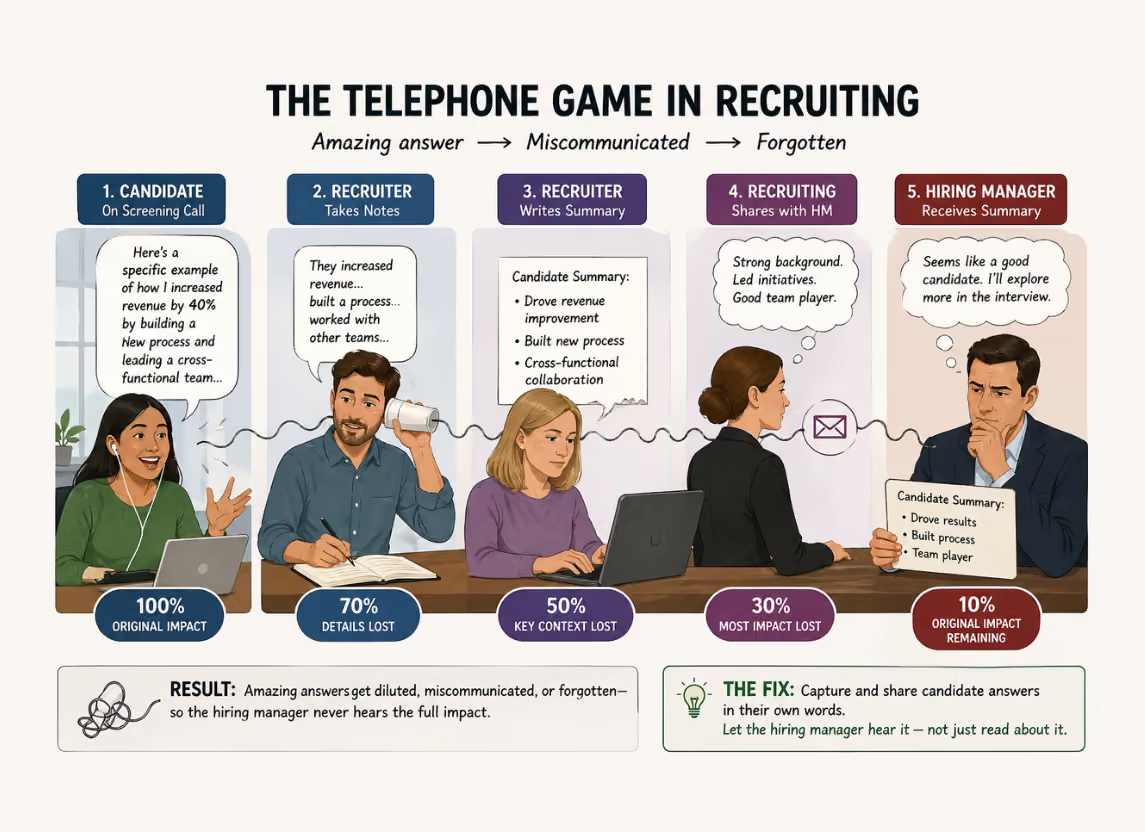
In 2015, while the Honeit team was a startup working out of the Berkeley SkyDeck, we wrote about a simple but costly problem in hiring: the telephone game in recruiting. In that original post, Phone Interviews and the Telephone Game, we described how a candidate could share a thoughtful, detailed answer on a screening call, only for it to be reduced to notes, summarized, and passed along to a hiring manager. At each step, something important happened.
The signal weakened, and interview answers were lost and forgotten.
More than a decade later, the tools have changed, but the problem has not. Today, recruiting teams have AI transcription, automated summaries, and note-taking tools that promise efficiency. Even with perfect transcripts, hiring managers are still not experiencing the candidate’s actual answer. They are reading an interpretation of it, either from scribbled notes or AI-generated summaries.
At its core, recruiting is a signal detection problem. The strongest signal comes when a candidate explains how they solved a problem, led a team, or made a decision. It is not just what they say, but how they say it. It includes the clarity of their thinking, the structure of their response, and the confidence in their delivery.
When that signal is reduced to notes or summaries, it degrades. A compelling answer becomes a few bullet points. A differentiated candidate starts to sound generic. By the time it reaches the hiring manager, what remains is no longer the candidate’s voice, but a filtered version of it.
This has real consequences. Great candidates sound average. Hiring managers fill in gaps with assumptions. Recruiters become responsible for translating and defending their summaries instead of simply sharing what actually happened. The process becomes slower, less aligned, and more prone to misinterpretation.
Back in 2015, the issue was manual note-taking. Today, even with AI, the industry still relies heavily on text-based outputs. Transcripts create a record, but they do not preserve the full signal. Reading a candidate’s answer is not the same as hearing it.
The best recruiting teams in 2026 have made a fundamental shift. They are no longer treating interviews as mere documentation. They are treating them as something to deliver. Instead of passing along summaries, they are sharing high-fidelity representations of candidate conversations. This preserves nuance, clarity, and intent.
👉 Hear an example candidate presentation with actual interview answers from a phone screen.
At Honeit, this has been the focus from the beginning. From our early days at SkyDeck to today, we have been laser-focused on solving this fundamental problem. That means eliminating miscommunication, reducing misinterpretation, and preserving candidate signal across the hiring process.
What started as better conversation capture has evolved into interview intelligence. This includes structured, shareable insights built from real-time interview data. It enables true interview collaboration, where recruiters and hiring managers operate from the same source of truth and make faster, more confident decisions.
The telephone game does not belong in modern recruiting. The teams that win in 2026 and beyond will not be the ones with the best notes. They will be the ones with the clearest signal.
If you are still relying on summaries to represent candidates, you are still playing the telephone game.
It is time to stop translating interviews and start sharing them.
👉 Book a Honeit demo to see how leading recruiting teams are capturing real conversations, sharing candidate answers, and delivering interview intelligence that preserves signal from the very first call.